
Plymouth County Court Records After Arrest
A Plymouth County arrest can create several records at once. Police make arrest paperwork, PCCF may create booking and custody records, and the Plymouth County District Attorney's Office decides how to proceed in court. The court record begins when charges are filed or scheduled for arraignment. That record may show the docket number, court department, event dates, attorneys, charge status, bail, warrants, dispositions, and future hearings.
Mass.gov says the public and attorneys can access basic case information and scheduled court dates through Trial Court electronic case information. The Mass.gov docket-search guide explains that dockets may be searched by docket number, case type and date range, or party name in some case types. MassCourts itself warns that the portal is not the official court record, so certified copies still come from the clerk.
Find Court Records After Arrest
The strongest search key is a docket number from paperwork, a daily list, a clerk, or MassCourts. Name searching can be limited for criminal matters, and sealed, impounded, juvenile, or confidential records may not appear. If the arrest is recent, check the court and date of arraignment first.
- Open MassCourts eAccess and choose the Trial Court department and location.
- Search by docket number when known. Use court, date range, or daily list details when the docket is not known.
- Review the charge list, event dates, party names, and docket entries, keeping in mind that online data is not certified.
- Contact the clerk for certified docket entries, dispositions, orders, or documents that are not public online.
- Use the Plymouth County DA public-records page for prosecution records, subject to exemptions.
The jail side remains separate. For custody, booking, or release details, use PCCF or the sheriff's RAO. For booking photos, use the Plymouth County jail mugshots page and the sheriff public-records route.
The screenshot below comes from the MassCourts public case-information portal, the statewide entry point for basic docket research.
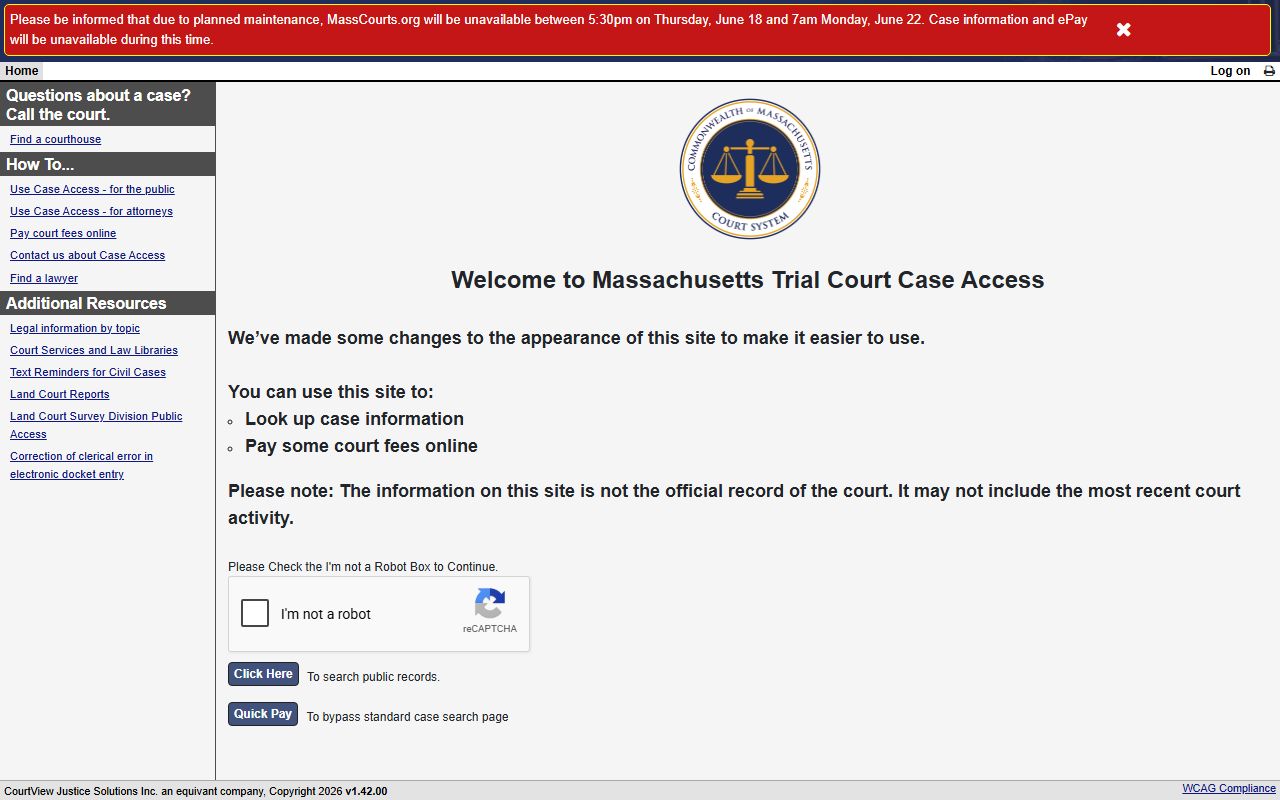
MassCourts is useful for case status and dates, but the Trial Court keeps certified records through the clerk's office.
Plymouth County Court Search Fields
MassCourts search fields vary by department and case type. For Plymouth County criminal matters, docket details and court/date details are more reliable than broad name searches.
| Field | Type | Use | Notes |
|---|---|---|---|
| Court Department / Division | Dropdown | Required | Choose District Court, Superior Court, Juvenile Court, or another department as appropriate. |
| Docket Number | Text | Best key | Use the number from paperwork, daily lists, or clerk communications. |
| Case Type / Date Range | Dropdown/date | Optional | Useful when the arraignment date is known. |
| Party Name | Text | Limited | Name search availability varies, especially for criminal cases. |
Charges Filed After Arrest
Booking charges can change. The DA may proceed by complaint, indictment, or another Massachusetts criminal charging path. The court docket, not the jail intake sheet, is the place to check what charges are pending now.
| Document | Where It Fits | Plain Meaning |
|---|---|---|
| Complaint | Often District Court | A charging document that starts many criminal cases. |
| Indictment | Superior Court | A grand-jury charging document for serious cases. |
| Application or related filing | Varies | A court filing that may lead to or support a criminal charge. |
Plymouth County Charge Status
Charge status can change at arraignment, pretrial conferences, motion hearings, plea dates, or trial. A charge is an accusation. A conviction requires a plea, verdict, or other final finding.
| Status | Meaning |
|---|---|
| Pending | The charge is active and has not reached final disposition. |
| Dismissed | The charge ended without a conviction on that count. |
| Nolle prosequi | The prosecution declined to proceed on the charge. |
| Amended or reduced | The filed charge changed from an earlier version. |
| CWOF | A Massachusetts continuance without a finding, which is not the same as a guilty finding if conditions are met. |
| Default or warrant | A failure to appear or comply may have led to a warrant event. |
Bail After Plymouth County Arrest
Massachusetts bail is controlled by court authority. M.G.L. c. 276, Section 58 covers release on recognizance or bail, while Section 58A covers dangerousness hearings for qualifying cases. A clerk-magistrate, bail commissioner, or judge may set release terms depending on timing and case posture.
Before posting money, confirm the exact amount, court, payment method, and whether another hold exists. A DOC hold, ICE detainer, federal hold, probation warrant, or another court warrant can stop release even after bail is addressed. Inmate account deposits through Access Corrections are not bail.
Warrants and Court Records
No official Plymouth County Sheriff's active-warrant public search portal was located. Bench or default warrants usually appear through the underlying court case, the clerk, or docket events. Local police may handle arrest warrants, while warrant records may be limited if active, investigatory, or safety-sensitive.
Record route: A warrant arrest can create a jail booking record at PCCF, but the court docket explains why the warrant issued and what the judge did next.
Charges vs Convictions
People often treat an arrest, a charge, and a conviction as the same event. They are not. A court record after a jail arrest may show one or more accusations, but the final disposition tells whether a charge ended in dismissal, plea, trial verdict, CWOF, or another result.
| Charge | Conviction | |
|---|---|---|
| Stage | Accusation filed in court | Final guilty finding, plea, or verdict |
| Record source | MassCourts, clerk, DA records | Certified disposition from the court |
| Effect | Does not prove guilt | Can affect sentencing, probation, and criminal history |
Plymouth County DA Records
The Plymouth County District Attorney's Office handles state criminal prosecutions after many Plymouth County arrests. Its public-records page says the office maintains records related to criminal investigations and prosecutions and asks requesters to be specific. DA records are not the same as court dockets or sheriff booking records. A DA response may be limited by investigatory, privacy, victim, witness, juvenile, impoundment, or CORI restrictions, especially while a case is active.
Use the DA route when the needed record is a prosecution record, not a custody record. Certified docket entries and dispositions come from the clerk. Booking records and jail status come from PCCF or the sheriff RAO. Police reports often belong first to the arresting police department, although copies may also appear in court or DA files depending on the case.
Sealed and Expunged Records
Massachusetts records can be limited by sealing, expungement, impoundment, juvenile confidentiality, CORI restrictions, privacy exemptions, and investigatory exemptions. M.G.L. c. 6, Section 167 defines CORI, and Section 172 governs dissemination. Sealing limits public access. Expungement is narrower and treats eligible records as removed under the controlling law.
| Sealed | Expunged | |
|---|---|---|
| Public view | Hidden from most public searches | Removed or treated as not existing for many purposes |
| Who decides | Court or statute-based process | Court or statute-based process |
| Jail record effect | May limit what agencies release | May require agency handling under the expungement order |
Public Record Search
Sponsored Results